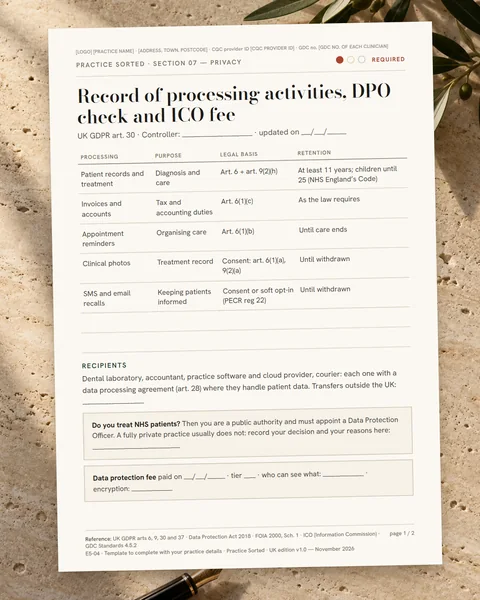
Record of processing activities, DPO check and ICO fee
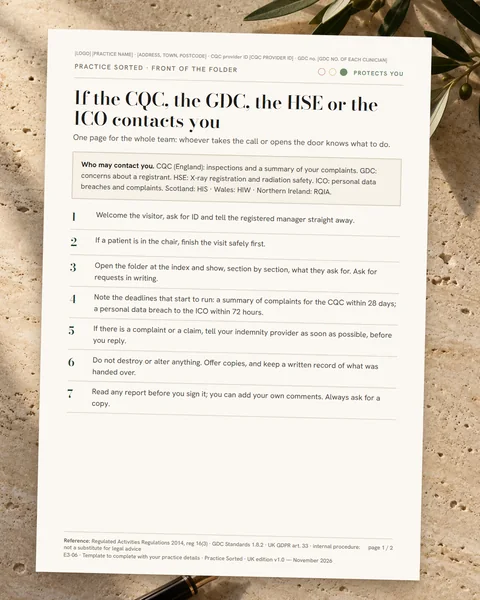
Under the UK GDPR, a personal data breach must be reported to the ICO (the Information Commission) within 72 hours of you becoming aware of it, unless it is unlikely to put anyone at risk, and you must log every breach, even the ones you don’t report. 61 ready-to-edit templates, UK edition: written for practices in England, with a note on every sheet that changes in Scotland, Wales or Northern Ireland. The reference is on every page.
No consultant, no adapting forms from overseas.
30-day guarantee · Secure payment · Templates by email within 48 hours
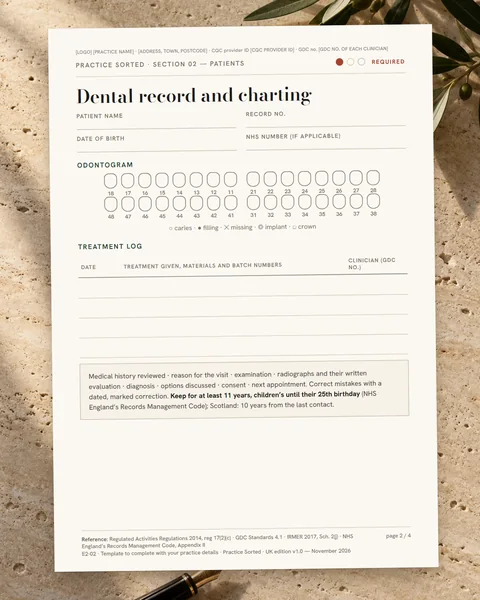
NHS England’s Records Management Code says dental records should be kept for at least 11 years, and children’s until their 25th birthday. Could you find a 2016 file in a minute?
If you recognised yourself in even one of these,
Practice Sorted was made for you.
Open the folder and run through the checklist: in 10 minutes you know what’s missing. The rest is already written: you adapt it once and print it.
Less paperwork at night. More peace of mind when the phone rings.
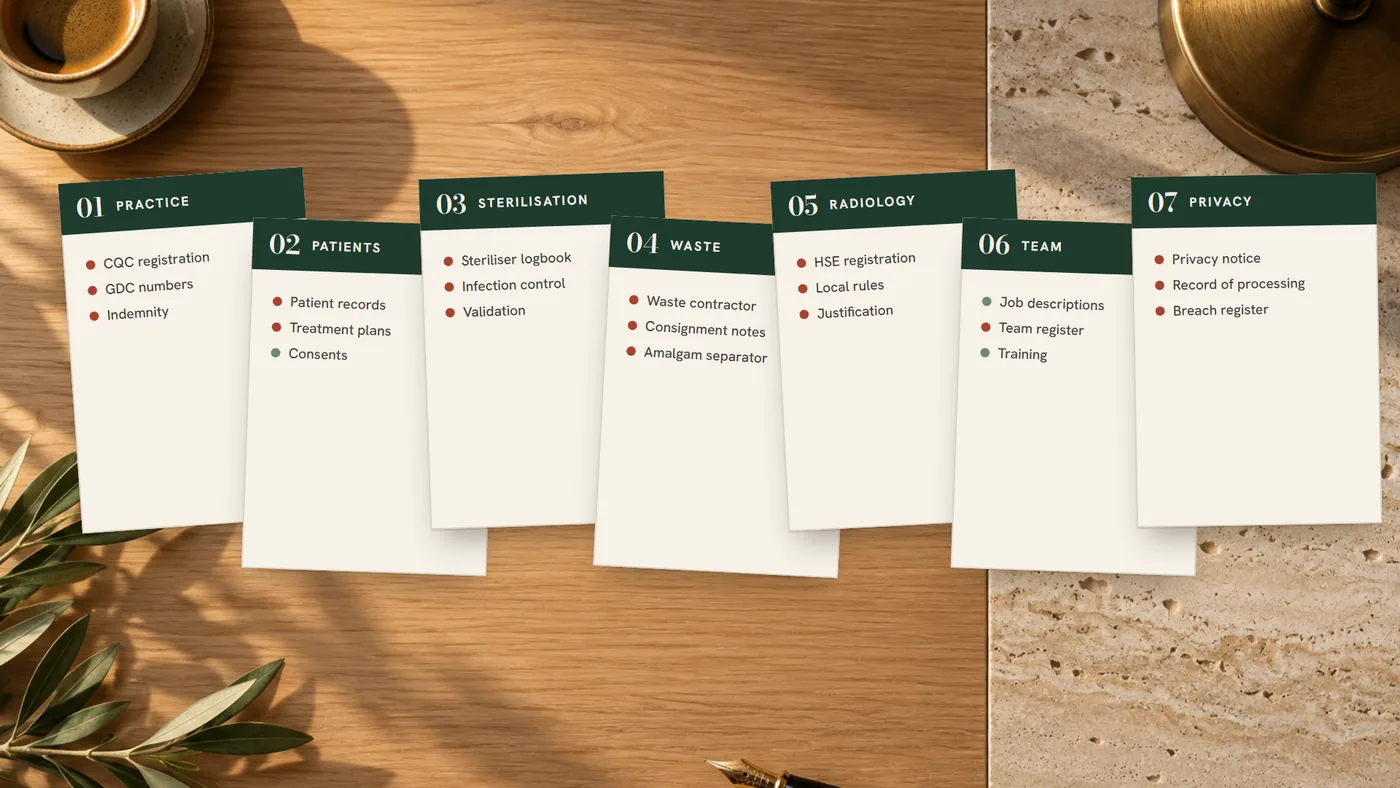
Every template in Practice Sorted has a dot that tells you whether it applies to you. Answer 7 questions, one for each section of the folder.
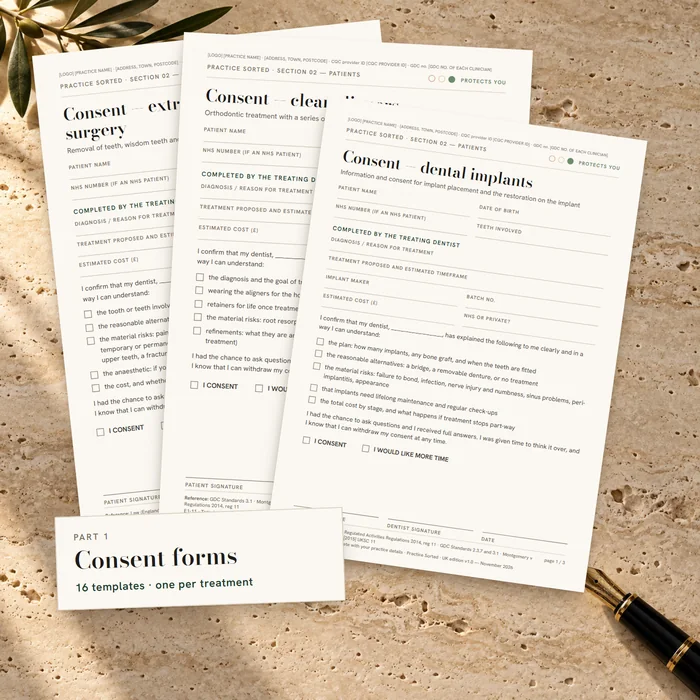
Solves‘I have one consent form for everything and I’m not sure it protects me.’
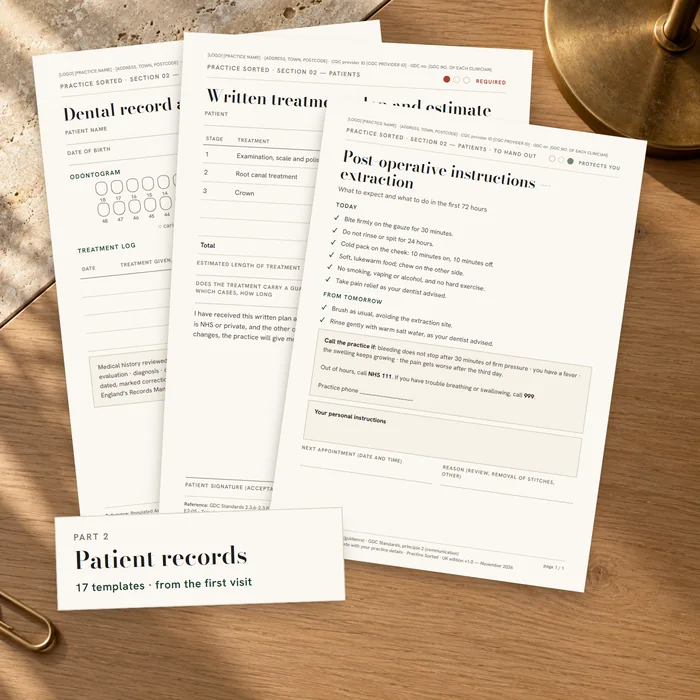
Solves‘If a patient complained, I’m not sure my records would hold up.’
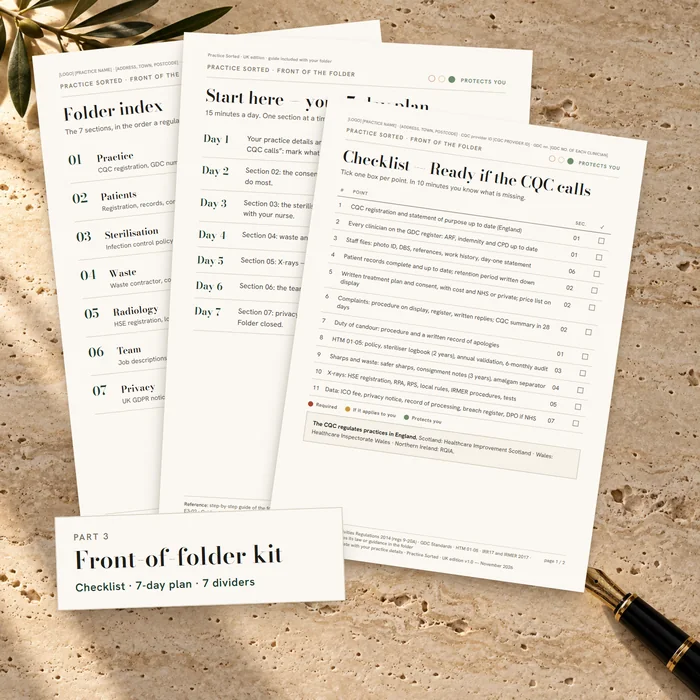
Solves‘I don’t know what’s missing, or where to start.’
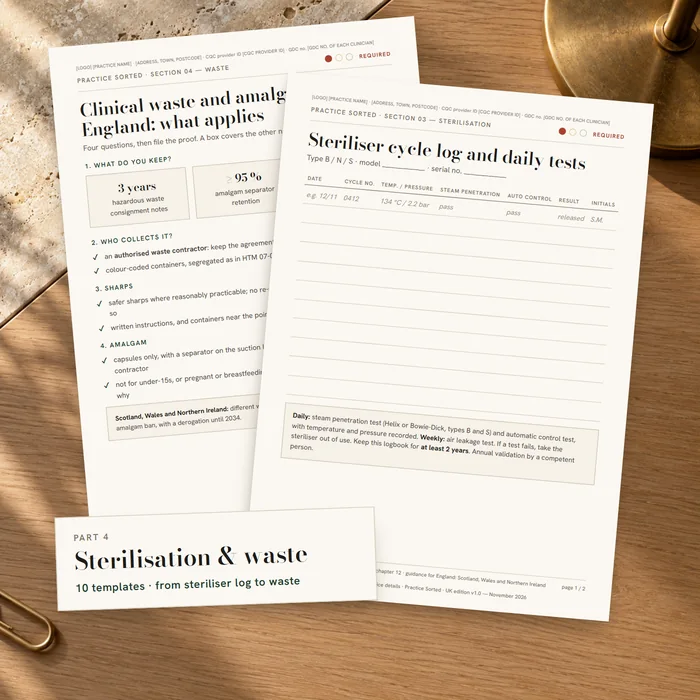
Solves‘My steriliser records are scattered and I don’t know what to keep for waste.’
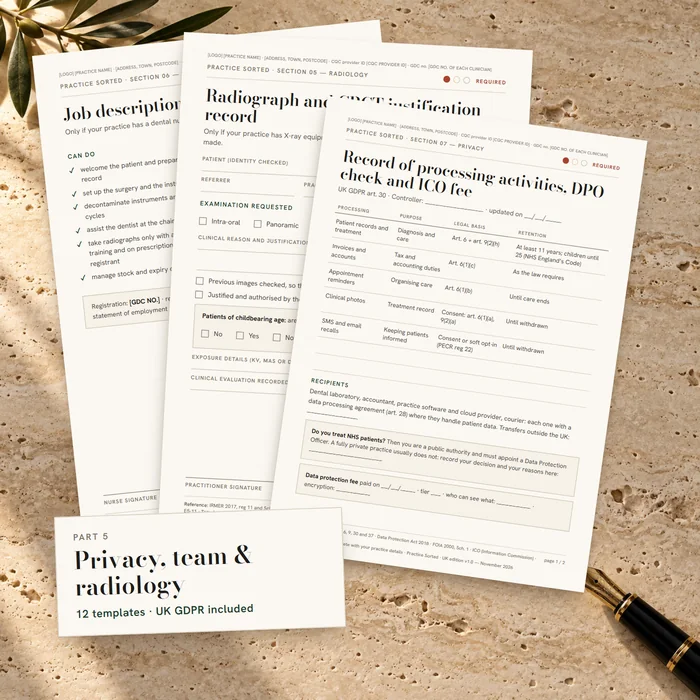
Solves‘UK GDPR, staff and X-rays: I’m not sure I’ve got it all.’
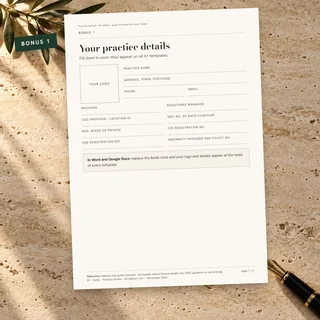
‘I don’t have time to edit 61 templates.’
Enter your practice details, registration numbers and logo once, then carry them into every template with a simple find-and-replace, in Word or in Google Docs.
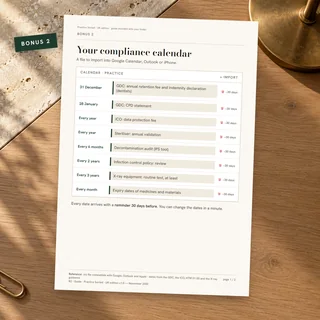
‘I always forget a deadline.’
The GDC renewal and indemnity declaration, your CPD statement, the ICO fee, steriliser validation, X-ray equipment tests and the review of your privacy notice: already in your calendar, with a reminder in advance.
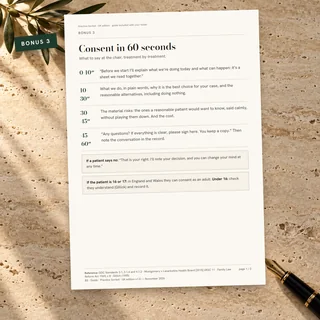
‘Patients get nervous, and I feel like I’m doing admin.’
The words to introduce each consent at the chair in one minute, treatment by treatment, covering the material risks, the alternatives and the cost, how to note it in the record, and the scripts for under-16s and 16–17-year-olds.
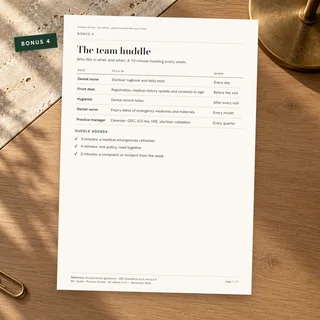
‘My team won’t use it anyway.’
One page per role (dental nurse, front desk, practice manager, hygienist or dental therapist) and a 10-minute huddle so you can start on Monday.
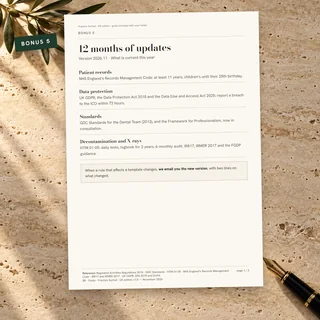
‘What if a law or a guideline changes again?’
When a UK rule or guideline we watch changes and affects a template, we email you the new version.
Bonus value: £25
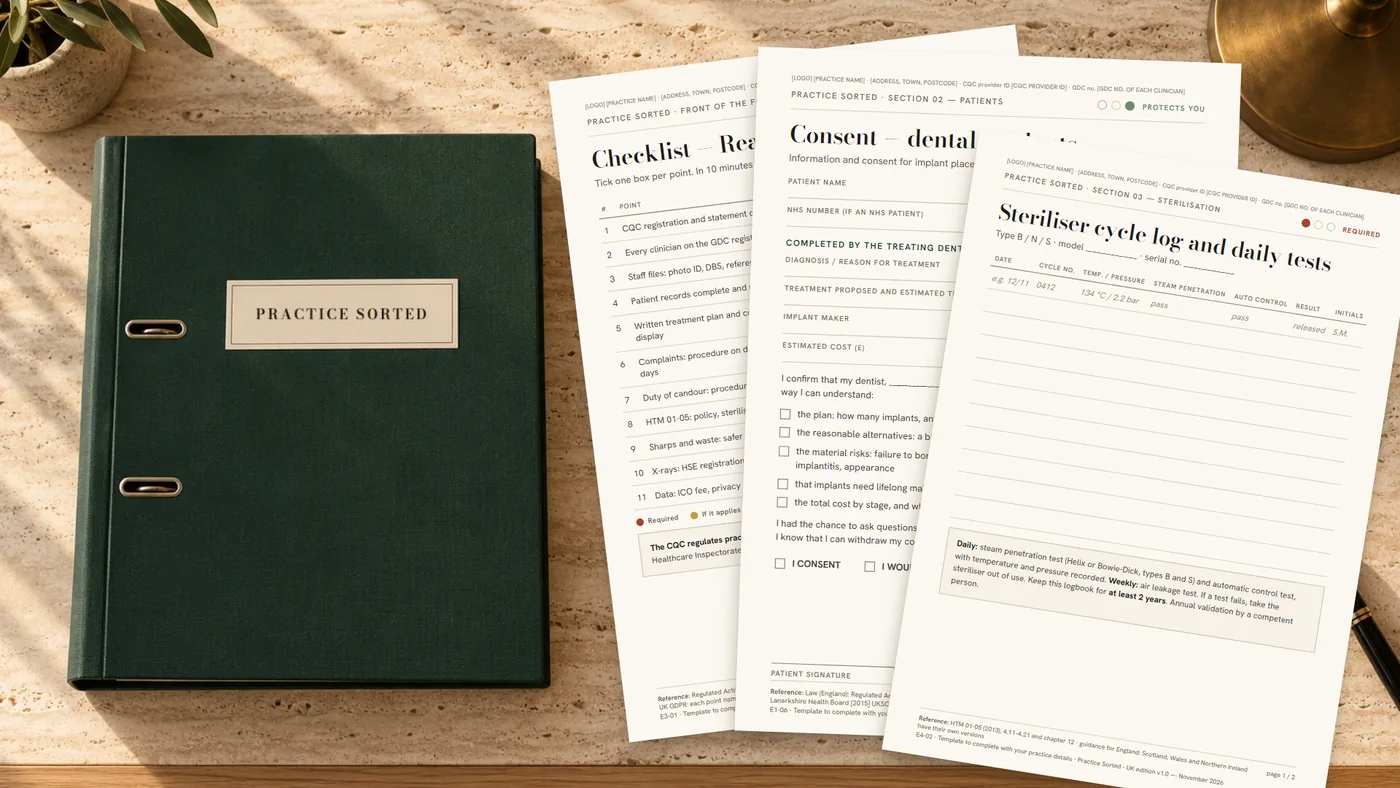
INCLUDED WITH THE FOLDERThe dot at the top, fields to fill in, signatures and the reference at the foot.
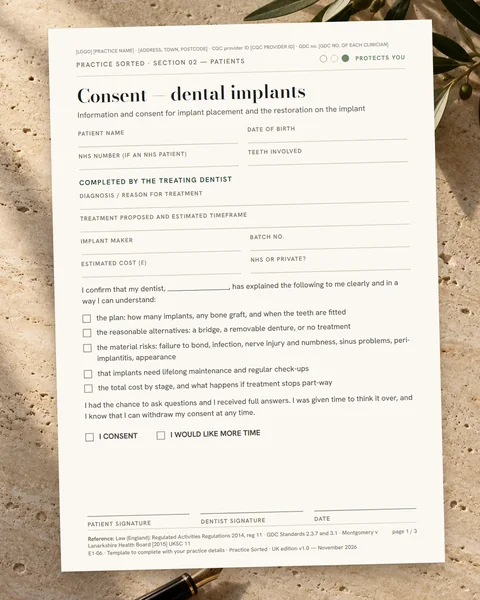
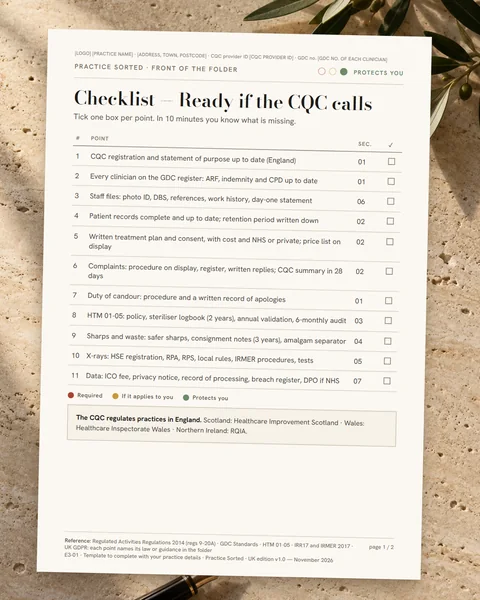
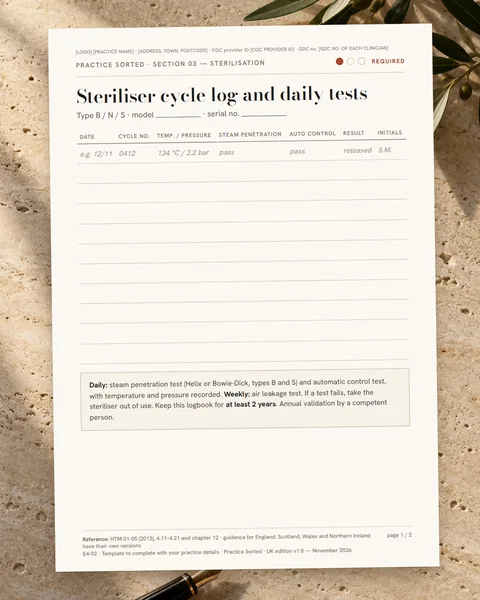
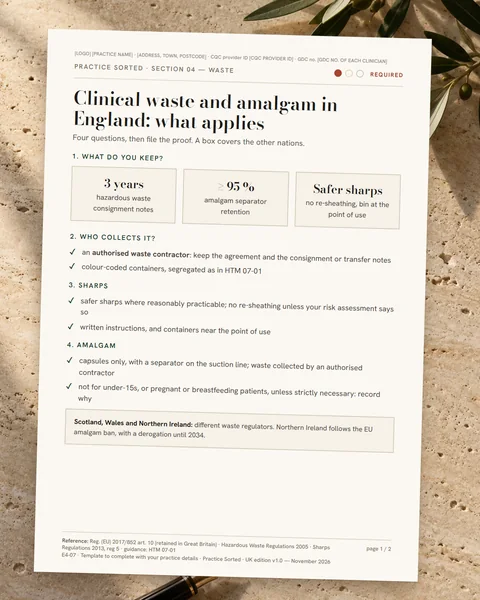
In Word and PDF · to print or fill in on screen
The 2026 Dental Practice Folder · 61 templates + 5 bonuses
Dental practices that sorted their folder.
“We had one consent form for everything. Now each patient signs the one for their treatment. With our logo on them, it took me one afternoon.”
“The checklist showed me straight away what was missing: our steriliser logbook only went back eight months. Two weeks later the folder was sorted.”
“Our steriliser printouts were loose in a drawer. Now it’s one section, by date, and every cycle is signed. Two minutes a day.”
“I hand out the extraction aftercare sheet as it is. Patients read it, understand it and ask fewer questions at the chair.”
“The aligner consent now covers wear time and retainers in writing. I always explained it out loud, but I never had it on paper.”
“I prepare the treatment estimates and the patient paperwork. In Word, already formatted: I don’t rewrite them for every new treatment. For £14.90 I didn’t expect this much.”
A Tuesday like any other, 8:30 am.
A patient has made a complaint and you are asked for a copy of their records and your response. Your dental nurse opens the green folder at page one: the index.
Section 02: the medical history is complete, and every treatment note has the date, the materials, the batch number and a signature.
For the implant: a written record of the consent discussion, signed by the patient and by you, with the material risks, the reasonable alternatives and the estimated cost explained.
You call your indemnity provider before replying, as the folder’s contact sheet suggests, and note what you sent. By nine you are back in the chair.
An example of how the folder is used. The outcome of any complaint always depends on the care as a whole.
Swipe to see the templates.
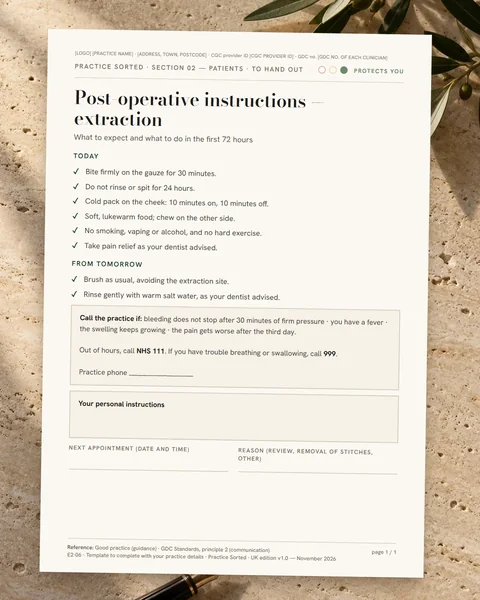
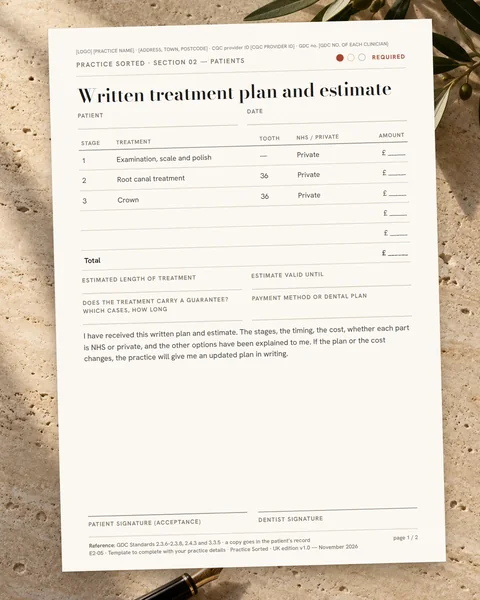
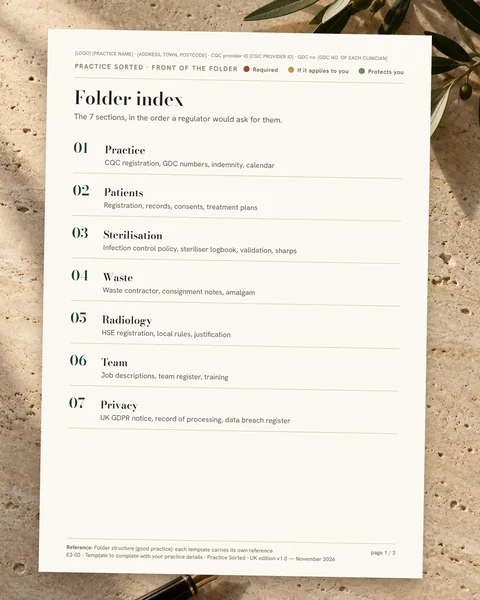
Or, from tomorrow, have the whole practice folder, written for UK practices and sorted.